← MuJoCo Sandbox

Engineering journal · September 10–12, 2026 · MuJoCo, MuJoCo Warp, PPO, RTX 4090

One learned controller for a robot dog, whole or missing a leg

A simulated Unitree Go2 loses a lower leg or a whole leg, and the same neural network has to keep it walking. PPO learns twelve joint targets at 50 Hz through torque-limited servos, with no gait script; only the route commands are scripted. The same network then learned to stop and stand on uneven supports and to balance on a moving deck, and one RTX 4090 replayed the whole curriculum from random weights in 22 minutes.

The complete showcase, 2 min 04 s at 1×: walking on all nine bodies, walk–stop–walk, pads, slopes, gaps and steps, then a moving deck. Recorded MuJoCo trajectories re-rendered in the native graphite theme, from three successive accepted checkpoints (walking v1, standing, moving), one shared actor within each stage. Strict misses stay labelled; cameras are observers, not policy inputs.
9 bodies
one frozen policy: healthy, four lower-leg and four whole-leg removals
288/288
v1 audit trials completed on allowed supports, reserved seed
22 min 05 s
RTX 4090 training from random weights to walk, stand and balance; 71.76 M experiences
136/144
strict balance checks for that final policy; walking 36/36, moving deck 24/24
3.23×
faster training with MuJoCo Warp physics at matched updates
Where this stands. Three accepted releases are tagged: walking on nine bodies (v1), standing on static supports, and balancing on a moving deck. A replay on one RTX 4090 then trained a single policy for all three from random weights in 22 min 05 s. Everything is simulated in MuJoCo. Joint control is learned; the lane and velocity commands are scripted; the policy is told which joints are missing rather than diagnosing it; the deck policy reads ideal platform state. Damaged bodies on a moving deck, unseen terrain and real hardware are not established. Every number on this page comes from recorded runs in the repository.

1 · Minutes, not hours

September 10 · the brief, the body, and the first pilot

The goal was one learned controller for a four-legged robot whose body has changed: a shortened or missing leg, a weak motor, or both. The user wanted a general controller that adapts whatever the state of the dog's legs, and set a hard limit on how it could be trained: "anything longer than a few minutes is not acceptable". Training time became an acceptance gate, starting at five minutes per final policy with every ancestor stage counted. The user later allowed more when a learning curve justified it.

The robot is the Unitree Go2 model from MuJoCo Menagerie. It is a free body, moved only by its own torque-limited joints and real ground contact. Damage is physical: removing a calf deletes its body, mass, collision geometry and joint. Before anything moved, we rendered the bodies and the course as static scenes and checked them.

The body (simulated)

  • Unitree Go2, 15.206 kg when healthy
  • 12 position servos, Kp 20 N·m/rad; torque caps 23.7 N·m at hip and thigh, 45.43 N·m at the calf
  • 2 ms implicitfast physics; trunk, leg and stump contacts all enabled

The policy (learned)

  • PPO actor 86 → 128 → 128 → 12 with ELU, 29,196 parameters; the same shape in every release
  • Reads joint angles and velocities, gyro, gravity direction, its previous action, the velocity command, 12 missing-joint bits and 9 range rays: it is told about damage, not left to diagnose it
  • Writes 12 joint-position offsets at 50 Hz; no gait clock, foot trajectory or added propulsive force

Training and scripting

  • 512 CPU MuJoCo worlds through mjbatch; network updates on the Mac's Apple GPU
  • A critic (90 → 128 → 128 → 1) also sees exact body velocity, height and damage, during training only
  • Scripted: a lane follower with ideal localization sends velocity commands; cameras are observers
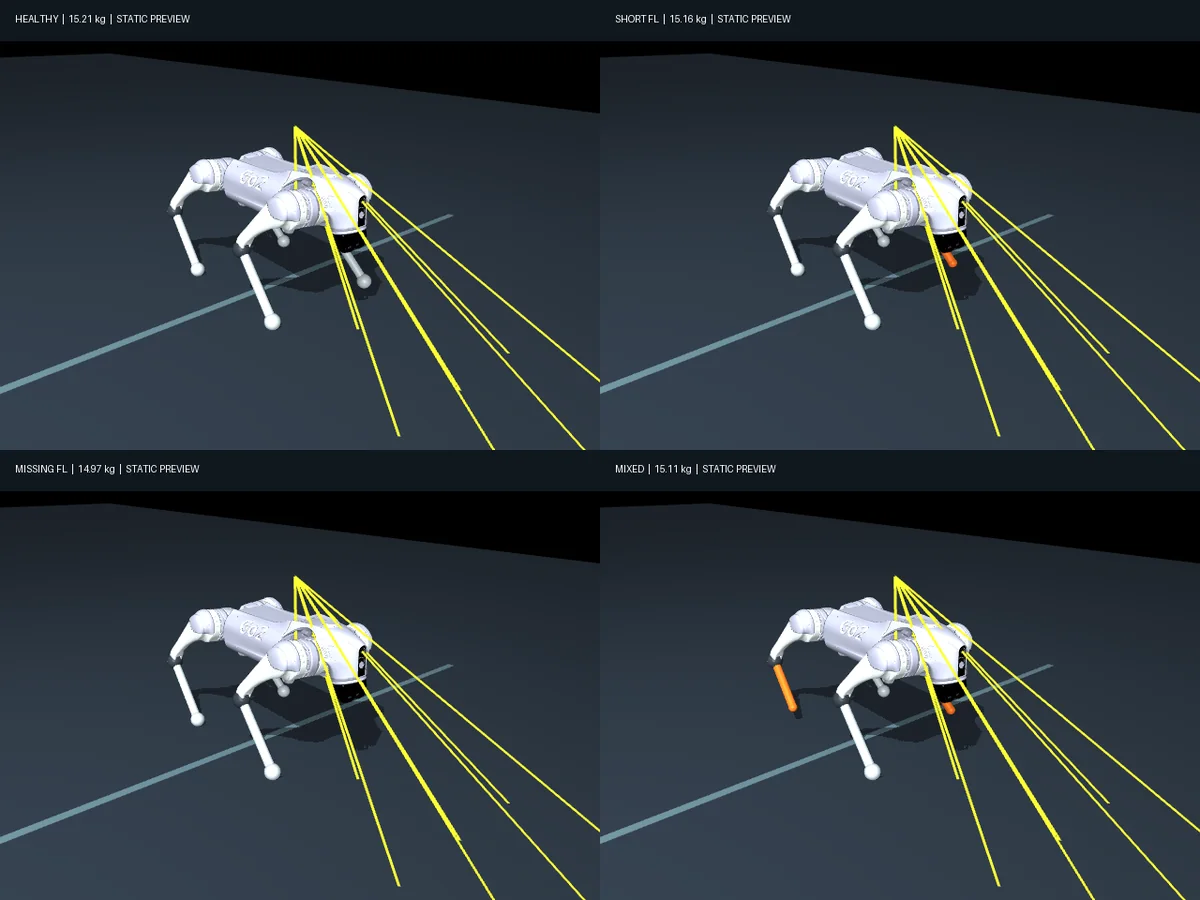
Four static Go2 bodies: healthy, shortened front-left calf, missing front-left calf, mixed damage
The first static check: healthy, shortened front-left calf, missing front-left calf and a mixed body, with masses from the compiled models. Yellow lines are the body-mounted range rays.
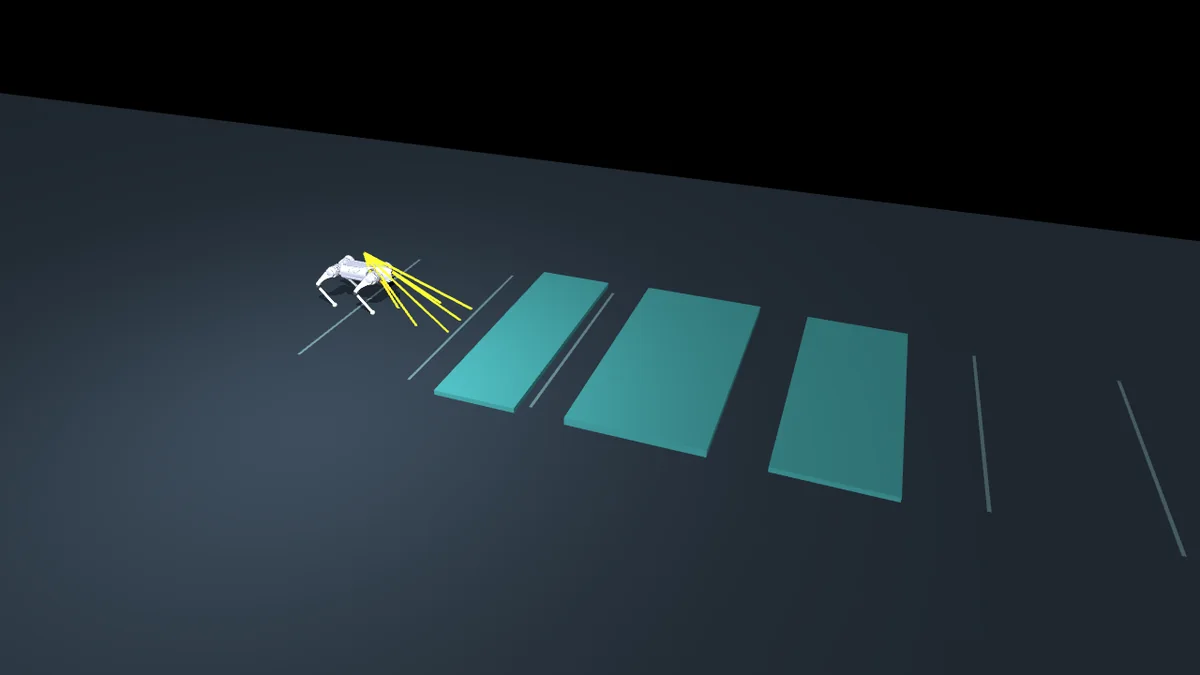
The Go2 at the start of a course with three low teal steps
The low-step course, rendered static before any motion.

First traction

The first pilot trained on shortened calves, weakened motors and low steps. Its selected reactive policy had 329.05 s of training in total, including a 59.81 s pretraining stage. The whole pilot, environment included, reached its validated checkpoint 51 min 45 s after the first implementation timestamp. At equal wall time we compared it with a history variant that adds a learned estimator over the last 0.5 s of feedback. The cases were frozen before the comparison, with 32 starting conditions each.

Frozen case, 32 trials eachReactive, 329.05 sHistory, 329.35 s
Healthy32/3232/32
Unseen front-right calf at 62% length32/3232/32
Two left calves at 78% and 86%32/3232/32
Short rear-right calf, rear-left hip dropping to 35% torque32/3232/32
New 3.5/5/4.5 cm steps with two shortened calves32/320/32
Rear-right calf and its joint removed0/320/32

Completion means reaching 5 m within 12 s and staying controlled in the goal lane for a second. These scores measure progress. The stricter support test of chapter 2 came later and was not applied to them. The comparison is an engineering test at equal wall time, not a clean ablation of memory: the simpler actor collected more transitions.

The 329-second reactive policy, 48 s at 1×, one checkpoint for four 12-second cases: front-left calf at 70% length, two shortened calves (75% and 65%), front-right thigh torque dropping to 25% at 3 s, and a shortened calf over 4/6/4 cm steps. All four reach 5 m. Recorded CPU MuJoCo rollouts; following, head and overview cameras are observers; lane commands are scripted.
Ten minutes made it forget. One approved extension resumed the reactive policy for 269.54 s (598.60 s in total) on healthy, shortened and missing front-left calves. Average missing-calf progress rose from 0.67 m to 3.92 m, but neither policy completed the 5 m task. The longer run lost all 32 two-shortened-calf completions and all 32 low-step completions, and its inspected missing-calf run leaned on the trunk in 50 of 600 sampled frames. It was not promoted. Keeping old skills while learning new ones became the next problem.

2 · The dog was walking on its knee

September 10 · 15:02 UTC · the user saw what the checks missed

A healthy-only walker had passed our checks: four feet touched the ground and the trunk did not. Watching its video, the user wrote: "the healthy dog is walking, his back right leg on the elbow, instead of foot/paw". The measurement agreed. The rear-right knee housing was resting on the ground in 155 of 600 sampled frames. Scored with a force-based test, the policy still reached 5 m in 32 of 32 trials and walked validly in none.

The fix measures what carries the weight. Every robot collision geometry got a native MuJoCo contact-force sensor against the ground, and the allowed supports follow the actual body.

Physical legAllowed ground support
Intact calf and footThe foot
Shortened calfIts modelled end surface
Calf and its joint removedA designated stump at the thigh tip
Weak motor, unchanged legThe same foot as before

Knees, shafts, thighs, hips and the chassis are penalized in the reward (weight 2), and evaluation fails a trial if any of them carries more than 1 N at any 2 ms physics step. The policy's inputs did not change: the sensors feed only the reward and the validator. No gait, foot path or posture was added.

0/ 32
valid walks by the original healthy policy
it still reached 5 m in 32/32
64/ 64
valid walks after the support cost, fresh seed
16/16 at a 1 ms step; forbidden forces 0 N
89.4s
of fine-tuning, 512 CPU worlds
208.6 s from random weights in total
19min 59 s
from the report to a verified fix
elapsed, including training and video
Same start, same physics, 12 s at 1×. Left: the original walk (119.2 s of training), flagged INVALID SUPPORT. Right: the support-cost policy (208.6 s) on its feet. The right side also had more training, so this is not an equal-budget comparison.
Count load, not touch. Contact checks said the gait was fine; contact forces said it was not. From here on, every acceptance test checks support force at every physics step against a list of allowed surfaces for each body: intact feet or modelled stumps, never a knee.

3 · From shortened calves to missing legs

September 10–11 · even out the gait, then remove whole limbs

Short rounds followed, each one measured before the next. Two gait-balance terms adapted from Isaac Lab's Spot task evened out the healthy gait: 61% less stance-timing imbalance and 64/64 support-valid trials, after 403 s of training in total. A paired-damage stage then took four bodies with two shortened calves from 33/128 to 127/128 support-valid completions with 89.4 s more training.

Then the user approved dropping shortened legs to focus on complete removals: the entire calf and foot, or the entire hip, thigh and calf. A lower-leg removal leaves a modelled 15 mm stump at the thigh tip as an allowed support. A whole-leg removal leaves three feet and nothing else.
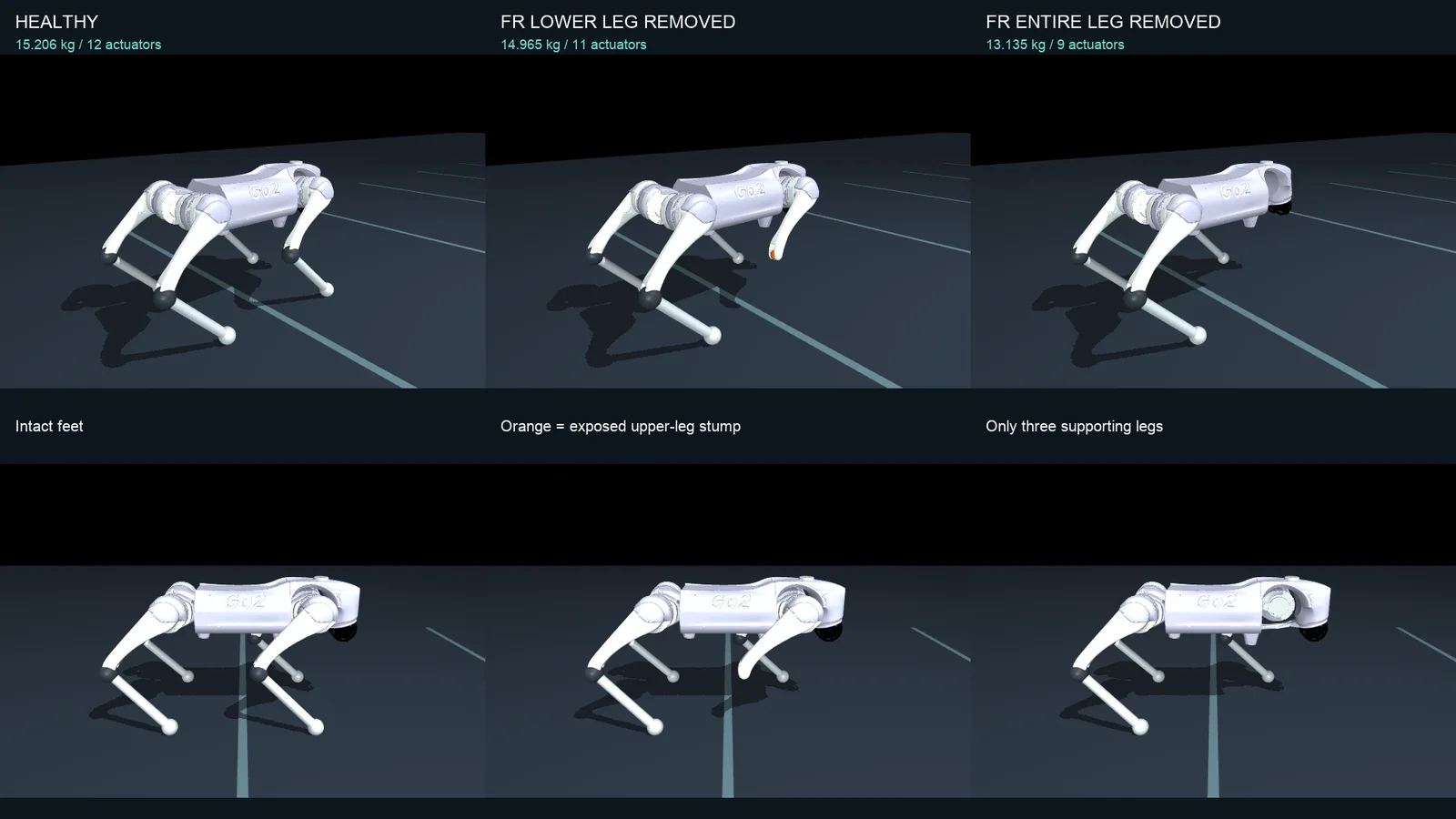
Static Go2 bodies: healthy, front-right lower leg removed with an orange stump, front-right entire leg removed
The removal bodies, static: healthy (15.206 kg, 12 actuators), front-right lower leg removed (14.965 kg, 11; orange marks the stump) and front-right entire leg removed (13.135 kg, 9). The other three positions mirror these.
Condition, 32 fresh starts eachHealthy parentSelected policy
Healthy32/3232/32
Lower leg removed: FL, FR, RL, RR, each0/3232/32
Entire leg removed: FL, RL, RR, each0/3232/32
Entire leg removed: FR0/3230/32
All eight removals0/256254/256

Five runs used 597.2 s (9 min 57 s) of new training on the Mac. The selected policy's full ancestry is 764.7 s, including its healthy parent. All 288 trials survived on allowed supports. The two front-right misses crossed 5 m too late to hold the goal lane for a full second, so they count as failures.

An input the network had never seen move. During healthy training the missing-joint bits never changed, so the weights reading them were never trained. An absent joint then arrived as an input clipped at 10 standard deviations. Zeroing only the newly used hip and thigh weights before the whole-leg stage gave it a neutral start; PPO still learns them.
Front-right removals stood still. After about 298 s of new training, six removal conditions passed 8/8, but both front-right bodies stayed put with valid support (0/8 each). A focused extension learned them (16/16) but lost lower-FL and whole-RL, and its final checkpoint lost whole-RR survival. A last consolidation round, using reference actions during training only, brought every removal back: 254/256.

4 · v1: one policy, nine bodies

September 11 · the gait the user accepted · tag adaptive-dog-v1

The last rounds were steered by watching. Smoothness rewards cut abrupt command changes by 32% and roll and pitch rates by 54% (RMS, averaged over the eight removals), and a minimum-support term cut time in the air by 41%. The user then rejected a gait that passed its numbers because all its feet still appeared to drag. A visible-step reward made every intact foot lift, with mean swing peaks of 5.5–10.8 cm and 288/288 completions. With a front-right leg missing, the rear legs swung almost together, 6.5% and 10.6% of a cycle apart, against 58.7% and 58.2% in the front-left cases. A small rear-overlap cost, trained for 2 min 59 s, reduced that. The user called the result organic and realistic and asked for it to become the official release.

The official v1 video, 12 s at 1× (4K source shown at 1600 px): the same frozen checkpoint in all nine panels, independent rollouts on one clock. Orange spheres mark the removals. Learned joint control, scripted lane commands; runtime physics 0.5 ms, control 20 ms (training used 2 ms).
288/ 288
fresh audit trials completed on allowed supports
seed reserved until after selection; 72/72 at a 0.25 ms step
32min 03 s
selected training ancestry, 38.4 M transitions
512 CPU MuJoCo worlds, Apple GPU learner
9
bodies, one frozen checkpoint
no switching, no learning during deployment
Rear-leg timing missed its gate. In the front-right cases the rear legs end up 17.6% and 11.0% of a cycle apart, short of the 25% target. The user preferred the natural gait; the release record keeps that gate as failed rather than relabelling it.
Penetration above target. The accepted video's lower-FR rollout reaches 8.889 mm of sampled contact penetration, against an unchanged 8 mm target. Torque caps hold and every task uses allowed support.
Scope. Single removals on flat ground, present from the start of each episode. The policy is told which joints are missing; diagnosing damage by itself is not demonstrated. 84 tests pass, and the viewer command checks the checkpoint's hash before running.

5 · Moving the physics onto the GPU

September 11 · same network and rewards, MuJoCo Warp on an RTX 4090

v1's physics ran on the CPU, so a GPU could speed up only the network updates. MuJoCo Warp runs the batched rigid-body and contact physics on the GPU, with one CUDA stream for each of the nine physically different body batches. Observations and rewards are still computed in NumPy on the CPU. Before any new training we fixed the rules: the same actor, critic, rewards, bodies, contacts, torque limits and clocks; minibatches independent of the number of worlds; paired runs with equal experience and optimizer steps; final checkpoints evaluated on CPU physics.

The first matched test failed. At 512 worlds and identical updates, Warp trained 1.71× faster but its policies completed 183/216 tasks against the CPU's 198/216, with the gap at the front-right removals. The predeclared gates failed and the result is kept. The same weights covered almost identical distances on both engines, which pointed to drift during training rather than a difference at run time.
4,096 worlds, same updatesCPU trainingWarp trainingSpeedupCPU tasksWarp tasks
Seed 246.740 s15.286 s3.06×67/7270/72
Seed 345.269 s13.542 s3.34×65/7271/72
Seed 444.763 s13.493 s3.32×68/7264/72
Pooled136.772 s42.321 s3.23×200/216205/216

With 4,096 worlds and the same number of updates, the two backends fell within the declared margins. Throughput rose from 12,937 to 41,811 transitions per second, and all 432 trials stayed upright on allowed supports. This continues a pretrained walker; it is not learning to walk in 42 seconds.
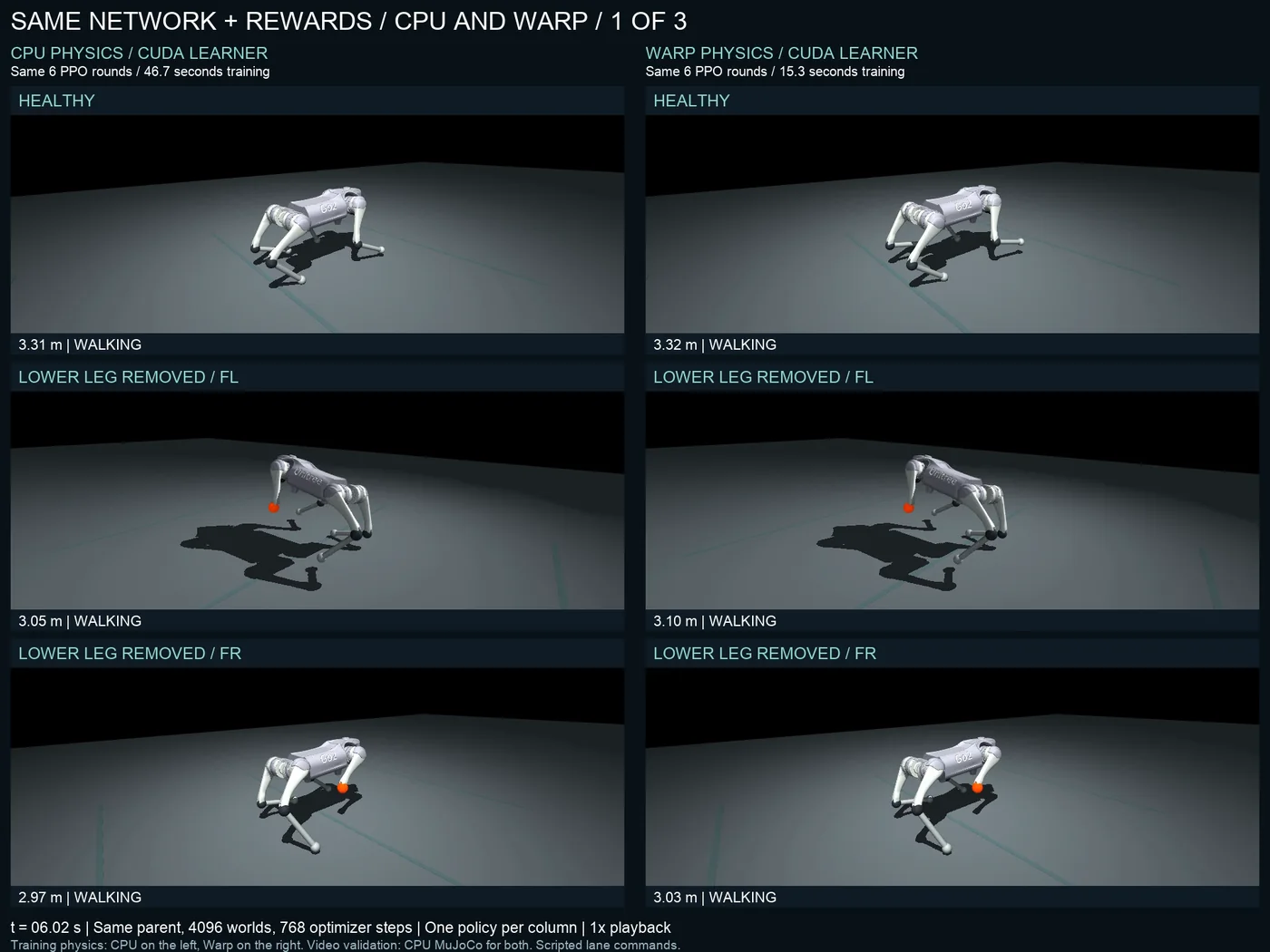
Side-by-side panels of CPU-trained and Warp-trained policies walking with lower legs removed
The matched pair for seed 2: the CPU-trained policy (left, 46.7 s) and the Warp-trained one (right, 15.3 s), from the same parent and the same 768 optimizer steps, both run in CPU MuJoCo for validation. A still from the 36 s comparison film, whose Warp lower-FR trial reaches 8.090 mm of penetration, over the 8 mm target; that miss stays on record.
Faster sampling is not a better policy. Given an equal 90 s, Warp collected 3.64× more experience but scored 59/72 against the CPU's 70/72. A CPU control run with the same 40 rounds took 301.9 s and scored 60/72: longer continuation regresses on both backends. Backends are compared at matched updates, and further fine-tuning is evaluated before it is adopted.

6 · Learning to stand still

September 11–12 · walk, stop and balance on pads, slopes, gaps and steps · tag adaptive-standing-v1

Standing was a skill v1 lacked: frozen, it passed 0 of 18 gentle standing checks. A zero velocity command now means hold position. Inputs that had been reserved now carry four foot-contact bits, four downward ray distances, and ideal body velocity and hold-position error; they are zeroed while walking. The user extended the terrain to 19 surfaces: pads, slopes of 6° to 24° on both axes, steps up to 28 cm, and a missing support under one foot. A frozen walker and recorded walking examples kept the gait from being overwritten during training; neither runs at deployment.

Seven rounds on 4,096 MuJoCo Warp worlds took 536.7 s (8 min 57 s) of new training and 26.8 million transitions. This was fine-tuning v1, not training a dog from scratch in nine minutes: the ancestry totals 40 min 59 s.

144/ 144
holdout trials upright, on each backend
CPU and Warp, seed 9307
94/ 144
strict passes on CPU (Warp 96/144)
support, drift ≤ 15 cm, tilt ≤ 20°, penetration ≤ 8 mm
36/ 36
walking tasks retained
every original gait gate
8min 57 s
new training on 4,096 Warp worlds
ancestry 40 min 59 s

Flat holds, flat walk–stand–walk, ordinary pads, 6° and 12° slopes, the 18° side slope, high pads, 12 cm steps and both front missing-support cases pass 4/4 each. On the front gaps the lifted foot stays unsupported for the whole hold.

New skills compete with old ones. Training only the healthy body to stand made damaged walking drift. Mixing in all nine bodies on flat ground, 18 terrain groups and v1 walking rehearsal restored every walking gate. A contact-window kernel inside the Warp graphs then summed reactions at every 2 ms step, so the reward could see brief unintended support.
What still fails. The rear-left gap often finds a fourth support on the next pad; the rear-right gap uses unintended links and tilts too far; extreme pads and steep slopes drift past 15 cm; 20 and 28 cm steps lean on links or tilt too far. Some damaged transitions reach 10.318 mm (CPU) and 9.492 mm (Warp) of sampled penetration. A reset-only pose solver starts the gap-side foot raised: the learned part is keeping balance from there, not discovering how to lift the leg.
The accepted standing release, 67 s at 1×: walk–stop–walk with three cameras, ordinary supports, harder terrain, eight reviewed terrain trials (0:32–0:52), damaged-body holds and a results card. 25/25 trials stay upright and 10/25 meet every strict gate; misses are labelled. Same frozen weights throughout; the main footage was captured in MuJoCo Warp, the reviewed terrain in CPU MuJoCo.
Accepted by eye, flags unchanged. After a film of every failing condition, the user accepted the eight hard terrain cases as natural corrections, and that acceptance is recorded separately from the measured flags. A friction sweep of 0.8, 1.0 and 1.2 moved reviewed-terrain strict passes from 0/32 to 0/32 to 1/32, so the original friction stayed.

7 · A deck that moves

September 12 · translate, yaw, heave and rock · tag adaptive-moving-v1

The deck is a 1.6 × 1.2 × 0.1 m, 35 kg table on six servo joints with force limits of ±3,000 N on the slides and ±1,000 N·m on the rotations. It travels ±0.55 m on both horizontal axes, ±0.20 m vertically, ±1.4 rad in yaw and ±0.45 rad in pitch and roll. The dog stays a free body and is never repositioned during a run. "Hold still" now refers to the deck: position, height and velocity are measured in its frame, while tilt is still measured against gravity, so a rocking deck does not tell the dog to tip with it. The policy reads ideal platform state from the simulator and never sees the future motion command.

Three variants separate coordinates from learning: the frozen standing policy, the same weights with deck-relative inputs, and newly trained weights. Two rounds took 118.6 s of new GPU training, with half the worlds on moving decks and half rehearsing static tasks on all nine bodies.

22/ 24
strict holdout passes after training
frozen 16/24; relative inputs only 16/24; CPU and Warp agree
24/ 24
holdout trials upright
four stationary-deck controls included
0/ 8
strict passes, damaged bodies on the deck
untrained transfer; 6/8 survive on each backend
118.6s
new training, 5.5 M transitions
ancestry 42 min 58 s
The first round broke standing. It improved the moving checks but stopped staying upright on two static conditions it had not rehearsed. The corrective round added every static surface and a training-only rehearsal of the frozen standing policy; it is the one selected. The two remaining holdout misses are brief unintended link support during combined motion.
The accepted comparison, 64 s at 1×: five ten-second motions with frozen standing, relative inputs only and trained (left to right), then a three-camera replay of the trained combined motion and a results card. On the video seed, strict passes are 15/20, 14/20 and 20/20, and all 60 trials stay upright. Captured in MuJoCo Warp; cameras are observers.

8 · The whole curriculum from random weights, timed

September 12 · 05:14 UTC · one RTX 4090, 4,096 worlds throughout

A summary had shown walking learned in "42 seconds". That number added up three benchmarks that continued an already trained walker; it never measured learning to walk. The user asked to "run it for real and really time it". We replayed the recorded curriculum from random weights: 30 stages (21 walking, 7 standing, 2 moving), one evolving actor, 4,096 worlds in every stage, and every training reference rebuilt from this run's own checkpoints.

Phase, each continuing the lastLearning timeNew experiencesExperiences/s
Healthy walking from random weights1 min 54 s9.63 M84,658
Adapt walking to missing limbs9 min 39 s29.79 M51,463
Standing on static supports8 min 23 s26.84 M53,318
Moving platforms2 min 09 s5.51 M42,643
Complete shared policy22 min 05 s71.76 M54,159

That is 398.68 hours of simulated experience summed across worlds, 717.6 million physics steps at 500 Hz, 730 rollouts and 93,440 optimizer steps. The timer covers physics, CPU observations and rewards, transfers, PPO updates and the rehearsal losses. Setup (187.8 s) and the final evaluation (50.1 s, on the Mac) are timed separately.

36/ 36
walking tasks, all nine bodies
healthy stride 32.22 cm, speed 0.558 m/s
136/ 144
strict static-balance checks
pads, slopes, gaps, steps, walk–hold–walk
24/ 24
moving-deck checks, healthy body
stationary controls included
204/ 204
trials upright, one frozen checkpoint
holdout seed, run in CPU MuJoCo
Eight static misses. All four 24° fore/aft-slope trials put weight on a link; one front-right lower-leg walk–hold–walk also uses unintended support; three rear-left lower-leg transitions drift 16.4–16.8 cm against a 15 cm limit. None falls, and no threshold or reward changed after these results.
What the timing is not. Walking sample counts were rounded up to whole GPU rollouts (39.4 M against 38.4 M historically, 2.66% more), so this is not an exact CPU-versus-GPU speed comparison. Two abandoned starts, 328.9 s and 158.0 s of learning, are kept outside the selected policy's time.
The final shared policy in all 51 evaluated conditions, in the 87 s cut of the 2 min 54 s film, at 1×: walking on nine bodies, walk–hold–walk, static terrain and moving decks, then training and results cards. One predetermined trial per condition, captured fresh in CPU MuJoCo: 51/51 upright and 49/51 strict, with both misses labelled. Ember is an observer-only colour theme.

9 · Native looks, and one generated trial

September 12 · presentation only; no physics or policy changed

The Go2 and Unitree names are part of the robot's mesh, so hiding the white lettering would leave the letter shapes recessed in the shell. The graphite theme instead draws thin curved covers in MuJoCo's observer scene. They follow the measured body and add no mass, collision or support. Tests that run themed and original models for 500 physics steps find every pose, velocity and sensor reading identical. The complete film at the top of this page replays the recorded trajectories in that theme at 1×; an earlier 2× edit is archived, since the user preferred normal speed.

Before that, one short paid trial ($1.98) sent five seconds of the accepted moving-deck film to Seedance 2.5 Video Edit through the WaveSpeed SDK, asking for brushed metal and a studio lab. It returned a metallic robot in a softly lit lab, but the legs, foot contacts and deck pose drifted from the original. The user paused generative styling and asked for better native MuJoCo rendering.
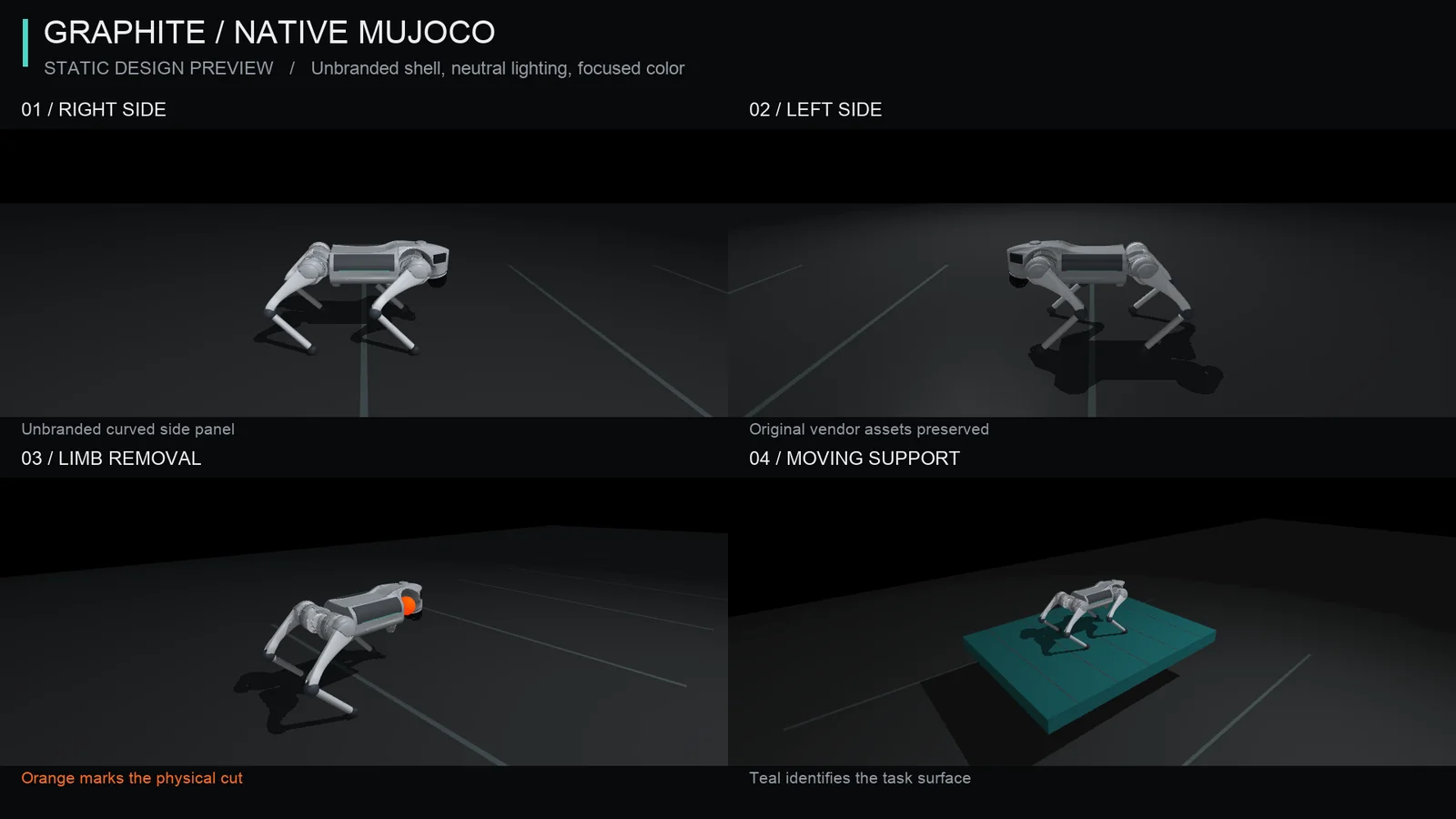
Graphite theme preview: unbranded shell, orange limb-cut marker, teal moving deck
The static graphite preview, rendered natively in MuJoCo: unbranded curved panels, vendor assets preserved, orange for a physical cut, teal for the task surface.
Generated video, not physics evidence. Left: the original MuJoCo render. Right: the Seedance 2.5 restyle, matched by elapsed time over the common 4.68 s at 1×. Limb and contact details and the deck pose diverge in the generated half.

10 · What comes next

Each step is measured with the same gates, seeds and support checks as above

  1. Damaged bodies on a moving deckMoving-deck training has used only the healthy dog. Adding the eight removal bodies is the direct next round; untrained, they pass 0/8 strict and survive 6/8.
  2. Infer the damage instead of being toldThe brief asked the controller to infer its body from recent interaction. Today it reads missing-joint bits. Replacing them with an estimator over recent feedback is the original objective, now on a much stronger base than the pilot's.
  3. Realistic sensingAdd sensor noise, encoder dropouts and latency, and estimate deck motion from the robot's own sensors instead of ideal platform state.
  4. Close the recorded gapsRear-leg timing in front-right removals, contact penetration above 8 mm, 24° slopes and the rear gaps; then terrain for the damaged bodies, which have stood only on flat ground.
  5. A fully GPU-side environmentObservations and rewards still run in NumPy on the CPU, which limits throughput. Moving them to the GPU is the next speed step after the 22-minute replay.
  6. More seeds, harder testsThree training seeds and larger held-out sets per condition, unseen terrain and multiple missing limbs, before any step toward hardware.